


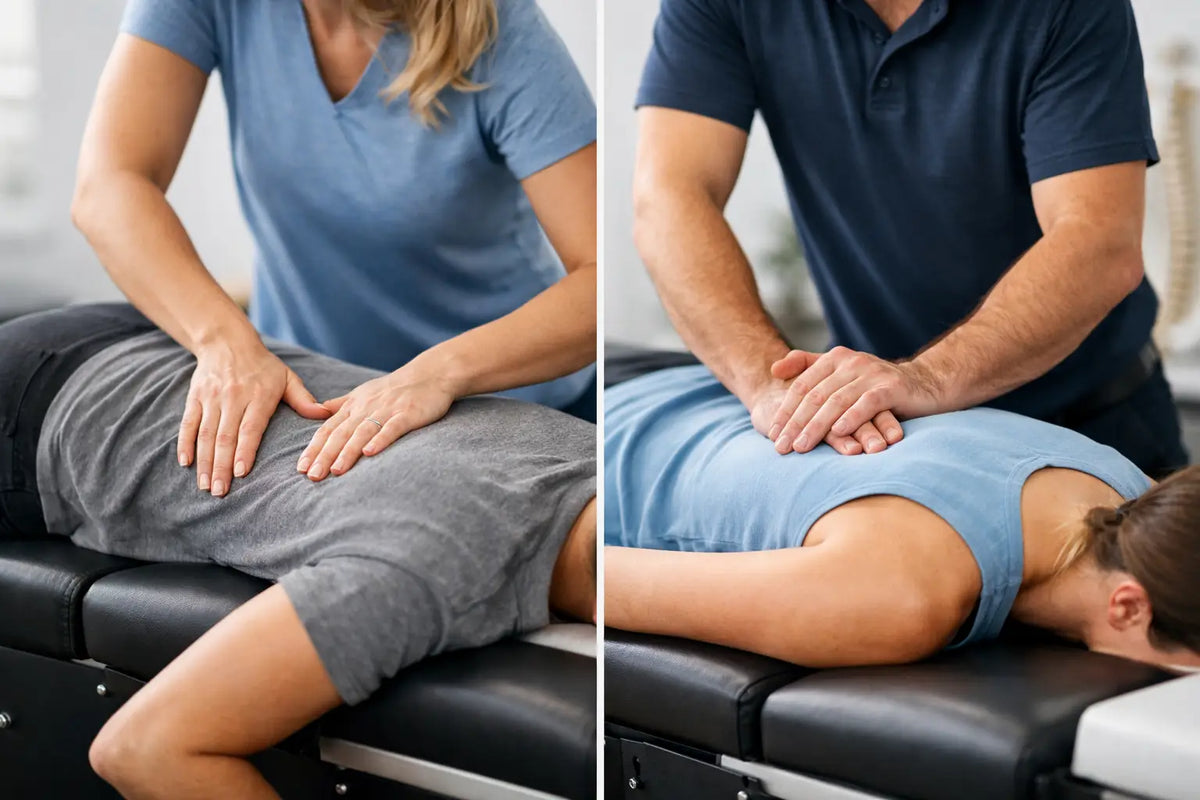
A drop section that releases too early, binds under load, or sits at the wrong height changes the adjustment before the practitioner delivers contact. That is why pelvic versus thoracic drops is not simply a question of table layout. Each section supports a different region, patient position, line of drive, and workflow inside the treatment room.
For clinics using drop-piece technique, the table is part of the adjusting system. Stable patient support, reliable cocking action, repeatable tension, and practical access all affect how confidently a practitioner can work. Pelvic and thoracic drops may look similar at a glance, but they are designed around distinctly different clinical demands.
Pelvic Versus Thoracic Drops: The Core Difference
A pelvic drop is intended to support adjusting procedures directed at the pelvis and adjacent lumbopelvic structures. The patient is commonly prone, and the practitioner typically uses a contact and line of drive selected to influence pelvic mechanics. Depending on the table design and technique, the section may accommodate one side of the pelvis or provide a broader pelvic support area.
A thoracic drop supports contact over the thoracic spine and upper trunk. Here, the goal is not merely to place a moving panel under the patient. The section must provide a stable chest platform while allowing the practitioner to position the patient, manage shoulder and arm placement, and access the appropriate thoracic level without creating unnecessary rotation or guarding.
The practical distinction is the load path. A pelvic drop manages force through a larger, denser body region close to the patient’s center of mass. A thoracic drop works under the rib cage and upper trunk, where patient comfort, chest support, and precise segmental positioning can be more sensitive. Both need dependable release characteristics, but they do not solve the same positioning problem.
What a Pelvic Drop Must Do Well
Pelvic drop work places a premium on stability. The pelvis is a substantial load-bearing region, and the table section needs to remain firm when the patient transfers onto it, shifts position, or relaxes into prone support. Any lateral play, weak cushion support, or inconsistent locking can interfere with setup and reduce practitioner confidence.
Section dimensions matter. A surface that is too narrow may leave larger patients feeling unsupported, while a poorly shaped cushion can make it harder to establish a neutral, comfortable prone position. The best configuration depends on the practitioner’s technique and patient population. A high-volume clinic treating a broad range of body types usually benefits from generous support, a strong frame, and a drop mechanism built for repeated cycling rather than occasional use.
Tension adjustment also matters, but more tension is not automatically better. The appropriate setting depends on the patient’s size, tissue tolerance, clinical presentation, practitioner contact, and preferred technique. A mechanism should allow practical adjustment and then hold its setting consistently through a full treatment day.
For many practitioners, pelvic access is closely tied to table height. If the table is too high, body mechanics suffer during prone adjusting. If it is too low, transitions and examination can become less efficient. A motorized hi-lo table with a wide height range helps preserve a usable working posture across different practitioners and patient sizes.
Patient positioning around the pelvis
Pelvic drop setup starts before the section is cocked. Confirm that the patient is centered, that the abdomen and hips are adequately supported, and that the leg position does not introduce unwanted rotation. The practitioner can then select the contact and line of drive according to training, examination findings, and the technique being used.
This is also where table upholstery earns its place. Dense, clinic-grade foam should support the patient without feeling harsh or allowing the pelvis to sink unevenly. The result is not a cosmetic detail. Consistent support makes repeatable setup easier from one visit to the next.
What a Thoracic Drop Must Do Well
Thoracic work often demands more careful attention to comfort and clearance. The rib cage, breast tissue, shoulder position, respiratory comfort, and the patient’s ability to relax all influence the setup. A thoracic drop should provide broad, stable support while still allowing access to the target area and a clear line of drive.
The release action needs to be crisp and repeatable. A hesitant drop can disrupt practitioner timing; a section with excessive looseness can feel unstable to the patient. In a busy clinic, those small inconsistencies accumulate. They slow transitions, create unnecessary rechecks, and make it harder to deliver the same setup from room to room.
Thoracic sections also benefit from thoughtful integration with headpiece and arm support design. A patient with poorly supported arms or an uncomfortable head position may tense through the upper trunk. That does not mean every thoracic setup requires the same accessory configuration. It means the table should give the practitioner enough adjustment range to create a stable, tolerable position for the individual on the table.
Thoracic access is not just about the drop panel
A well-designed thoracic drop works as part of the entire table architecture. The cushion contour, frame rigidity, headpiece travel, arm support, and overall table width affect access. A section can have a reliable mechanism and still become inefficient if the practitioner must repeatedly reposition the patient to reach the desired area.
For clinics that use diversified, Thompson-style, or other drop-assisted approaches, the right question is not whether a thoracic drop is available. Ask whether the table supports the way the practitioner actually sets up, contacts, and transitions between procedures.
Comparing Setup, Force Direction, and Workflow
Pelvic and thoracic drops should be evaluated by their real role in treatment delivery, not by a feature checklist alone. Four differences are especially useful when specifying a table:
- Support area: Pelvic sections must manage substantial lower-body loading. Thoracic sections must stabilize the upper trunk while protecting comfort around the chest and shoulders.
- Patient position: Pelvic work often centers on prone pelvic symmetry and leg position. Thoracic work may require more attention to arm placement, headpiece setup, breathing comfort, and upper-body relaxation.
- Practitioner access: Pelvic contacts often rely on a clear approach to the ilium, sacrum, or lumbopelvic region. Thoracic contacts require dependable access across varying thoracic levels without compromised posture.
- Workflow demands: A clinic that frequently alternates between pelvic and thoracic procedures benefits from controls and sections that cock, release, and reset predictably with minimal interruption.
Choosing a Table Configuration for Your Clinic
A table with both pelvic and thoracic drops can be a strong fit for a practice that uses drop-assisted procedures regularly across spinal regions. It can reduce room-to-room variation, limit the need for workarounds, and keep the practitioner on one stable treatment platform. But a more feature-rich configuration is only valuable when those features are used consistently.
Start with treatment mix. A clinic focused heavily on lumbopelvic complaints may prioritize pelvic stability, prone comfort, and elevation range. A practice that frequently works through the thoracic spine should evaluate chest support, upper-body positioning options, and how easily practitioners can access different levels. Multidisciplinary environments should also consider how the table serves examinations, manual therapy, mobility work, and patient transfers between chiropractic visits.
Then assess the structure beneath the cushions. Premium treatment tables should be engineered for daily professional use, with a high-capacity frame, stable base, durable upholstery, and serviceable components. A drop mechanism is only as dependable as the table supporting it. If the frame flexes, the base shifts, or the motorized elevation system is underpowered, even a well-designed section becomes less useful in real clinic conditions.
TRL Tables designs clinic-grade treatment platforms for practitioners who need that level of repeatability. For high-volume settings, details such as a 600 lb lift capacity, smooth elevation control, and long-term frame durability are operational advantages, not optional upgrades.
Common Equipment Mistakes to Avoid
The most common mistake is treating pelvic and thoracic drops as interchangeable modules. They may share a basic mechanical principle, but patient support and access requirements differ. Another mistake is choosing a fixed-height table to reduce upfront cost, then asking practitioners to adapt their body mechanics throughout the day.
Avoid selecting solely by the number of sections. A table with fewer, better-engineered features can outperform a crowded configuration with weak support, awkward controls, or inconsistent releases. Finally, test the full workflow: patient entry, prone positioning, section cocking, adjustment access, reset, and exit. A table that looks capable in a product comparison should also keep pace in a live treatment room.
The right drop configuration should disappear into the practitioner’s process. When pelvic and thoracic sections support stable positioning, predictable release, and efficient transitions, the clinician can keep attention where it belongs: on the patient, the assessment, and the quality of care delivered.
Share:
Does Traction Therapy Need Tables? Clinical Guide
Auto Flexion Chiropractic Tables for Modern Clinics