


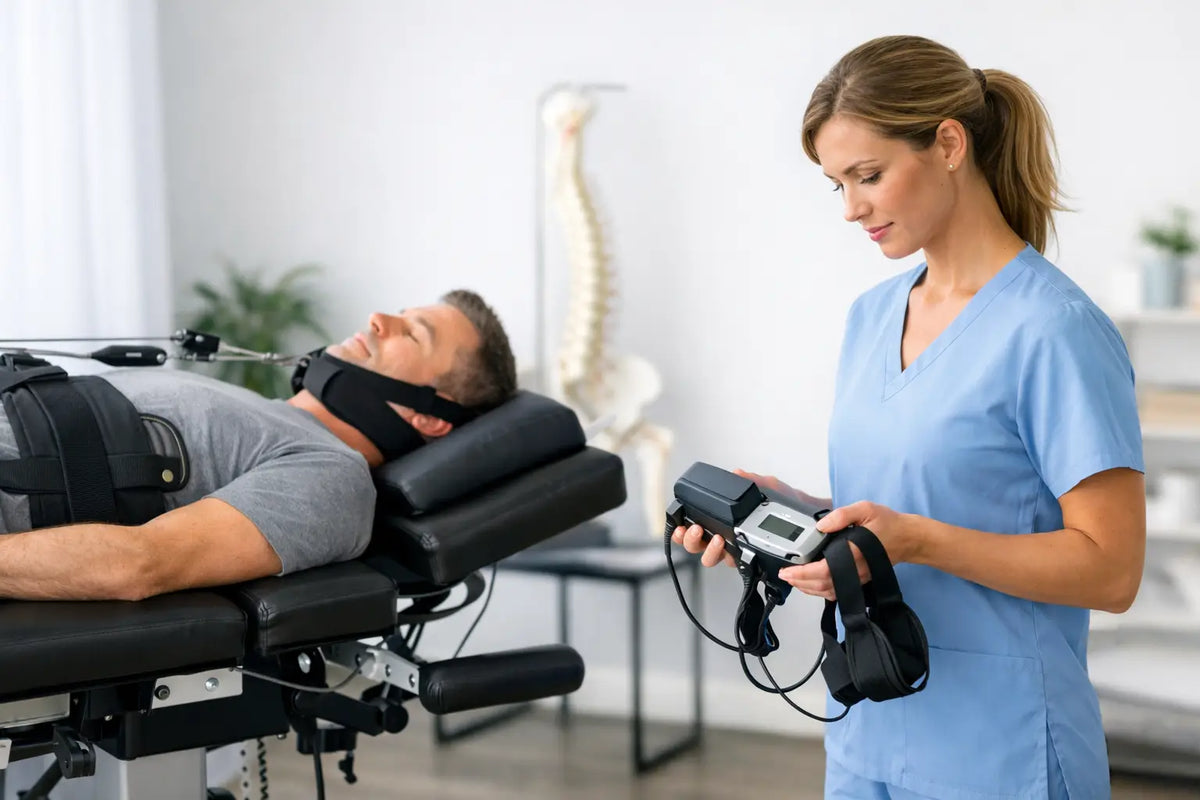
A patient arrives with acute lumbar symptoms, limited tolerance for prone positioning, and a treatment plan that includes mechanical traction. The clinical question is not simply whether traction can be applied. It is whether the setup will let the practitioner control force, positioning, time, and patient comfort without compromising the rest of the appointment. So, does traction therapy need tables? Not in every circumstance, but a purpose-built table is often the difference between improvised traction and a repeatable clinical procedure.
Does Traction Therapy Need Tables for Clinical Use?
Traction therapy does not universally require a dedicated table. Some forms of traction use portable devices, over-the-door cervical systems, manual techniques, or equipment configured around an existing treatment surface. These approaches may be appropriate in limited settings when they are selected and supervised by a qualified clinician.
For professional practices delivering mechanical spinal traction or decompression regularly, however, a dedicated traction or decompression table is usually the more capable platform. It is engineered to support controlled patient positioning, stable harness application, consistent force delivery, and efficient transitions between treatment methods. Those details directly affect how reliably a protocol can be delivered from one patient to the next.
The distinction matters because traction is not just a pulling force. It is a positioning-dependent intervention. Pelvic angle, thoracic support, cervical alignment, friction at the contact surface, and the patient’s ability to relax can all affect the treatment experience. A general-purpose table can support some traction applications, but it may not provide the sectioning, control, or integration needed for advanced protocols.
What a Dedicated Traction Table Changes
A traction table creates a stable, clinic-grade foundation for the procedure. The patient can be secured and positioned without relying on makeshift anchors, movable furniture, or a surface that shifts under load. For busy treatment rooms, that stability protects workflow as much as it supports patient comfort.
Dedicated systems are commonly designed with features such as motorized elevation, sectional surfaces, traction-ready attachments, adjustable bolsters, and controlled decompression settings. The exact configuration depends on whether the practice treats lumbar, cervical, or multi-region conditions, and whether traction is a primary service or one component of a broader plan of care.
Motorized height adjustment is particularly valuable when patients have mobility restrictions, higher body weight, or difficulty getting onto a fixed-height surface. A low entry height can reduce the challenge of transfers. Once positioned, raising the table allows the provider to work at a more appropriate ergonomic height when applying belts, adjusting supports, or combining traction with manual therapy.
Sectional movement can also matter. A table that supports controlled flexion, distraction, or separation between patient-contact sections may better accommodate protocols where friction reduction and regional positioning are essential. It is not a feature to buy for its own sake. It is a feature to select when it aligns with the techniques performed in the clinic.
When a Standard Treatment Table May Be Enough
A standard, high-quality treatment table may be sufficient when traction is occasional, low-complexity, or delivered through a portable system designed for use on a flat treatment surface. A clinic that performs limited cervical traction, for example, may not need a large integrated lumbar decompression system in every room.
The treatment table still needs to meet the demands of the setup. It should be stable, appropriately rated for the patient population, and large enough to support safe positioning. The upholstery should provide secure patient support without creating excessive friction or making transfers difficult. If belts, cables, or attachments are used, the manufacturer’s instructions and the equipment’s intended use must guide installation.
This option can make financial and operational sense for a newer practice, a satellite office, or a multidisciplinary clinic that uses traction selectively. The trade-off is typically speed and flexibility. Staff may spend more time assembling components, adapting patient position, and resetting the room. The setup may also offer less precise control than an integrated system.
A standard table becomes a weak fit when traction is performed frequently, when providers use flexion-distraction or decompression protocols, or when patients regularly require highly individualized positioning. At that point, the operational limitations become visible appointment after appointment.
When a Dedicated System Is the Better Investment
A dedicated traction table is generally the stronger choice when the clinic needs traction to be consistent, scalable, and central to treatment delivery. High-volume chiropractic offices, physiotherapy clinics, rehabilitation centers, and multidisciplinary practices often benefit because the equipment is built around the procedure rather than adapted to it.
Consider a dedicated system when the practice needs to address several practical demands:
- Traction or decompression is performed multiple times each day.
- Patients require repeatable lumbar, cervical, or pelvic positioning.
- The clinic treats patients with mobility limitations or a broad range of body types.
- Providers need faster room turnover without sacrificing setup quality.
- Traction is combined with flexion-distraction, manual therapy, or other table-based care.
For clinic owners, durability belongs in the same conversation. A table used for daily mechanical traction experiences repeated loading, patient transfers, moving sections, and constant cleaning. Consumer-grade equipment may appear adequate at first but often lacks the structural strength, serviceability, and control expected in a professional environment. Equipment engineered for clinical use should be evaluated for lift capacity, frame construction, motor performance, upholstery quality, replacement-part availability, and manufacturer support.
Patient Positioning Is Not a Minor Detail
The most capable traction unit cannot compensate for poor positioning. Patients must be assessed individually, fitted correctly, and monitored throughout care. The intended treatment angle, stabilization method, and force parameters should reflect the provider’s clinical judgment, the patient’s presentation, and any applicable contraindications or precautions.
A dedicated table supports this process by making positioning more manageable. Adjustable sections can help accommodate flexed or extended postures. Properly designed supports can reduce pressure points. Secure harness interfaces can help limit unwanted movement. These features do not make traction automatically appropriate, but they make it easier to deliver an appropriate protocol with greater consistency.
Comfort has clinical and business value as well. A patient who feels unstable, pinched by a poorly positioned belt, or anxious during transfer is less likely to relax through the procedure. Conversely, a controlled setup signals professionalism. It shows that the clinic has built its treatment environment around safety, precision, and patient experience rather than convenience alone.
How to Choose the Right Table for Traction Therapy
Start with treatment reality, not a feature checklist. Identify which regions you treat, how often traction is performed, and whether the table will also support examinations, manual therapy, rehabilitation, massage, or flexion-distraction work. A single versatile table can be the right answer for one practice. A dedicated decompression station may be the better answer for another.
Next, consider capacity and access. The table should safely accommodate the patient population you serve, including larger patients and those who need low-height entry. Smooth powered elevation is more than a premium convenience in these cases. It can improve transfers, reduce provider strain, and make treatment room flow more efficient.
Then evaluate control and service life. Mechanical components should move smoothly and predictably. The frame should feel planted under changing loads. Controls should be practical for the provider’s workflow, and the manufacturer should have a clear path for parts and support. A table is long-term clinical infrastructure, not disposable furniture.
For practices comparing premium options, TRL Tables focuses on the performance factors that matter in serious treatment rooms: stable clinic-grade construction, motorized control, high-capacity support, and configurations suited to advanced table-based care. The best model is still the one that matches the procedures your team performs every day.
The Practical Answer for Your Clinic
Traction therapy can be delivered without a dedicated traction table in selected situations. But when traction is a regular part of care, purpose-built equipment improves the conditions around the treatment: positioning becomes more repeatable, transfers become more controlled, and workflow becomes easier to manage.
Choose the table based on the standard of care your clinic intends to deliver, not the minimum setup that can technically perform traction. Equipment that supports precise treatment today should also be capable of supporting the volume, patient needs, and clinical expectations your practice is building toward.
Share:
What Is Flexion Distraction in Chiropractic Care?
Pelvic Versus Thoracic Drops: Clinical Differences