


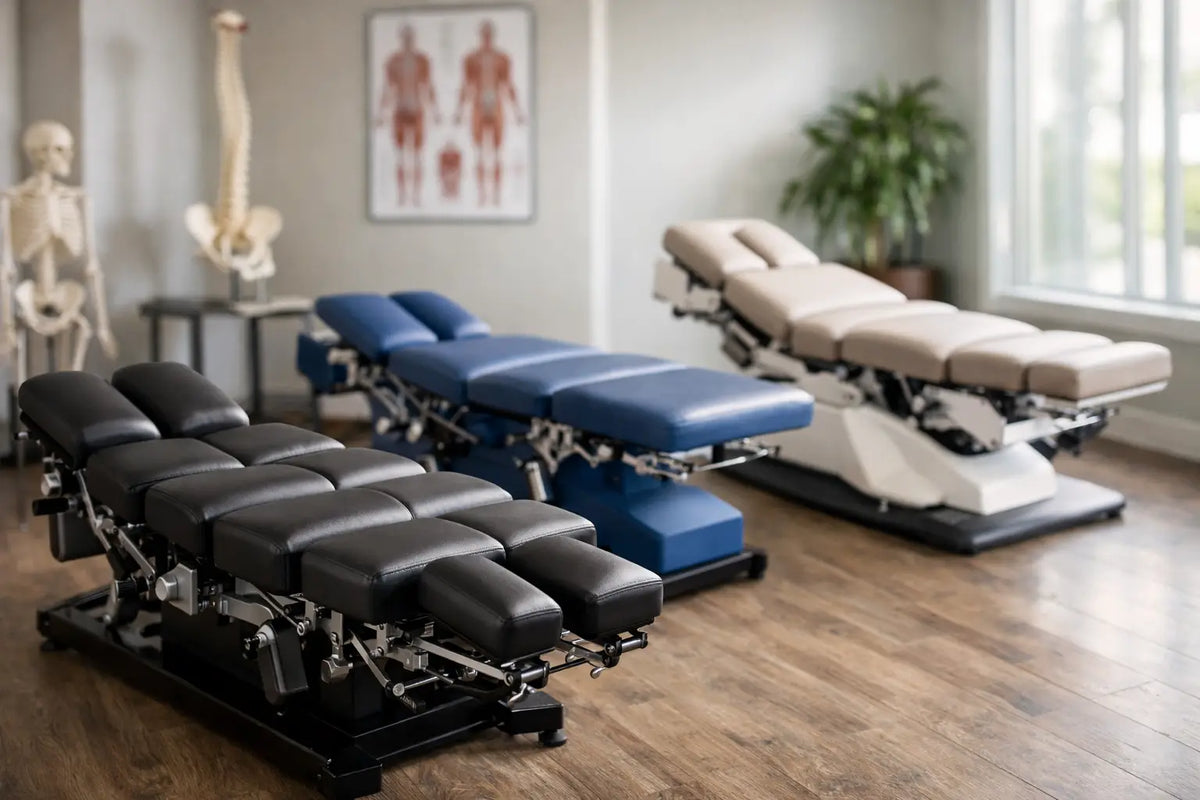
A chiropractic table is not a passive piece of clinic furniture. It determines how confidently you position patients, how efficiently you move through an adjustment, and whether your treatment room keeps pace on a full schedule. Knowing how to choose chiropractic tables starts with evaluating the treatments you deliver most often, then matching the table’s mechanics, capacity, and controls to that reality.
A lower-priced table can look acceptable on day one and become a daily compromise when elevation is slow, sections shift under load, or the surface cannot support the patient population you serve. A clinic-grade table should feel stable, controlled, and ready for repeated use from the first patient through the last.
Start With Your Treatment Model
The right table depends on what happens in your treatment room. A practitioner focused on diversified adjustments has different needs than a clinic that performs flexion-distraction, spinal decompression, rehabilitation, soft-tissue work, or a blend of all five. Buying more functionality than you will use can tie up capital. Buying too little can limit your treatment options as the practice grows.
Begin by looking at your actual appointment mix. Consider the techniques you use every day, the services you plan to add, the number of providers sharing each room, and the range of patient mobility levels you see. A high-volume clinic with older adults, post-surgical rehab patients, and larger patients needs a different platform than a startup practice delivering primarily manual adjustments.
Match table type to clinical application
A standard chiropractic table may be appropriate when your treatment model centers on manual manipulation and basic positional support. The critical question is whether its drop systems, section configuration, and working height support your preferred techniques without forcing awkward practitioner posture.
Flexion-distraction tables are built for more controlled lumbar and pelvic movement. If Cox-style work, disc-related presentations, or repetitive flexion protocols are central to your practice, look closely at the smoothness and range of the flexion mechanism, the stability of the pelvic section, and how easily settings can be adjusted between patients.
Motorized hi-lo tables are often the better operational choice for multidisciplinary clinics. Powered elevation reduces strain during transfers, helps accommodate patients with limited mobility, and lets practitioners set a more consistent working height. For clinics combining chiropractic, physiotherapy, massage, and rehab, this flexibility can improve room utilization without sacrificing clinical control.
Decompression and traction systems require even more specificity. Verify that the table is designed for the protocol you intend to deliver, not simply marketed with broad traction language. Patient restraint design, angle control, treatment programming, and the platform’s ability to hold position all affect treatment consistency.
Evaluate Frame Strength Before Features
A long feature list does not compensate for an underbuilt frame. The table’s structure is the foundation for patient confidence, practitioner leverage, and years of reliable performance.
Look for a welded steel frame engineered for professional treatment environments, not a light-duty construction intended for occasional wellness use. A table should remain planted during drops, repositioning, and manual force application. Any visible rocking, frame flex, or instability becomes more noticeable under the demands of a busy clinic.
Weight capacity matters for more than accommodating larger patients. It is an indicator of the engineering margin built into the table. A 600 lb capacity, for example, gives a clinic more confidence across a broad patient population while supporting the repeated loading that occurs every day. Review the manufacturer’s stated capacity and ask whether it applies to the full operating configuration, including elevation and moving sections.
Also consider the warranty in practical terms. A strong frame warranty signals that the manufacturer stands behind the core structure. It does not replace regular maintenance, but it can reduce long-term ownership risk when the table is a central revenue-producing asset.
Choose Elevation That Supports Your Workflow
Table height affects both patient access and practitioner ergonomics. A fixed-height table may work in a narrowly defined treatment setting, but it can create unnecessary compromises when multiple practitioners use the same room or patients have difficulty getting on and off the surface.
A motorized hi-lo table allows you to lower the platform for safer entry, then raise it to a working height that supports proper body mechanics. This is especially valuable for practitioners who work long clinical days and for facilities treating patients with mobility limitations. The goal is not simply convenience. It is to reduce avoidable physical strain and make patient positioning more predictable.
Pay attention to the lift system itself. Smooth, quiet operation contributes to a more professional patient experience, while responsive controls prevent treatment flow from slowing down. Foot controls can be especially useful when your hands are occupied with patient support or positioning. If a table uses digital or touchscreen controls, assess whether the interface is intuitive enough to use quickly between appointments.
For multi-provider practices, the ideal elevation range depends on who uses the table. A table that reaches a comfortable height for one practitioner may still be too low or too high for another. Test the full range whenever possible and consider the realities of your staff, not just your own preferred position.
Assess Sections, Drops, and Adjustability
The best table configuration is the one that allows precise patient positioning without adding unnecessary complexity. Headpieces, chest sections, pelvic sections, ankle extensions, and drops should each serve a clinical purpose.
For cervical work, assess how easily the headpiece adjusts and whether it provides stable support in the positions you use. For pelvic and lumbar techniques, check the motion, lockout, and feel of those sections under load. A section that feels loose or inconsistent can interfere with precise delivery and undermine patient trust.
Drop mechanisms deserve hands-on evaluation. They should cock reliably, release cleanly, and reset without distracting noise or excessive effort. Practitioners who use drops throughout the day will notice small inconsistencies quickly. A durable drop system should deliver repeatable performance rather than requiring constant adjustment or cautious handling.
Consider upholstery and cushioning with the same level of scrutiny. Patients need enough comfort to relax, particularly during longer decompression or flexion-distraction sessions. At the same time, overly soft cushioning can reduce positioning control and make transfers more difficult. Choose clinic-grade upholstery that is durable, easy to clean, and suited to the infection-control practices in your facility.
Plan for Patient Access and Room Flow
A table can meet every technical specification and still be a poor fit if it disrupts the room. Measure your treatment space before ordering. Account for the table at full extension, the clearance required for practitioners to work around it, door swing, storage, and the path patients use to enter and exit.
This matters most with flexion-distraction and decompression equipment, which may require more clearance than a basic adjustment table. You also need space for stools, traction accessories, exercise tools, and another clinician if your care model includes assisted treatment.
Think through the patient experience from arrival to departure. Can a patient using a cane, walker, or wheelchair approach the table safely? Can your team transfer a mobility-limited patient without awkward maneuvering? Does the layout let you move from assessment to treatment without repeatedly repositioning equipment? Good room flow protects time, safety, and the professional feel of the practice.
Compare Total Ownership Value, Not Just Purchase Price
When deciding how to choose chiropractic tables, purchase price should be only one part of the decision. A table that costs less upfront but needs frequent repair, limits patient access, or forces you to replace it as your practice expands can become the more expensive choice.
Evaluate the availability of replacement parts, technical support, warranty coverage, shipping considerations, and expected service life. Motorized equipment has more components than a basic manual table, so dependable support and parts access are particularly valuable. Financing can also change the decision by allowing a clinic to acquire equipment that meets its clinical requirements now rather than settling for a short-term compromise.
TRL Tables is built around this clinic-first standard: equipment engineered for daily professional use, with the structural strength, controlled movement, and service support serious treatment rooms require.
Test the Table Like You Will Use It
If you can evaluate a table in person, do not just sit on it and inspect the finish. Run through a typical treatment sequence. Raise and lower it. Engage the drops. Adjust the headpiece. Move the flexion section. Consider how it feels with realistic force and whether you can operate the controls while maintaining patient support.
Ask direct questions before you buy: What is the rated lift capacity? Which components are covered under warranty? How are replacement parts handled? What service is available in your region? How does the table perform after repeated cycles, not just in a showroom demonstration?
The table you choose becomes part of every treatment you deliver. Select the one that supports your technique, protects your workflow, and gives patients a stable, professional platform that reflects the standard of care you intend to provide.
Share:
Spinal Decompression Equipment Guide for Clinics
Motorized Elevation Treatment Tables for Clinics