


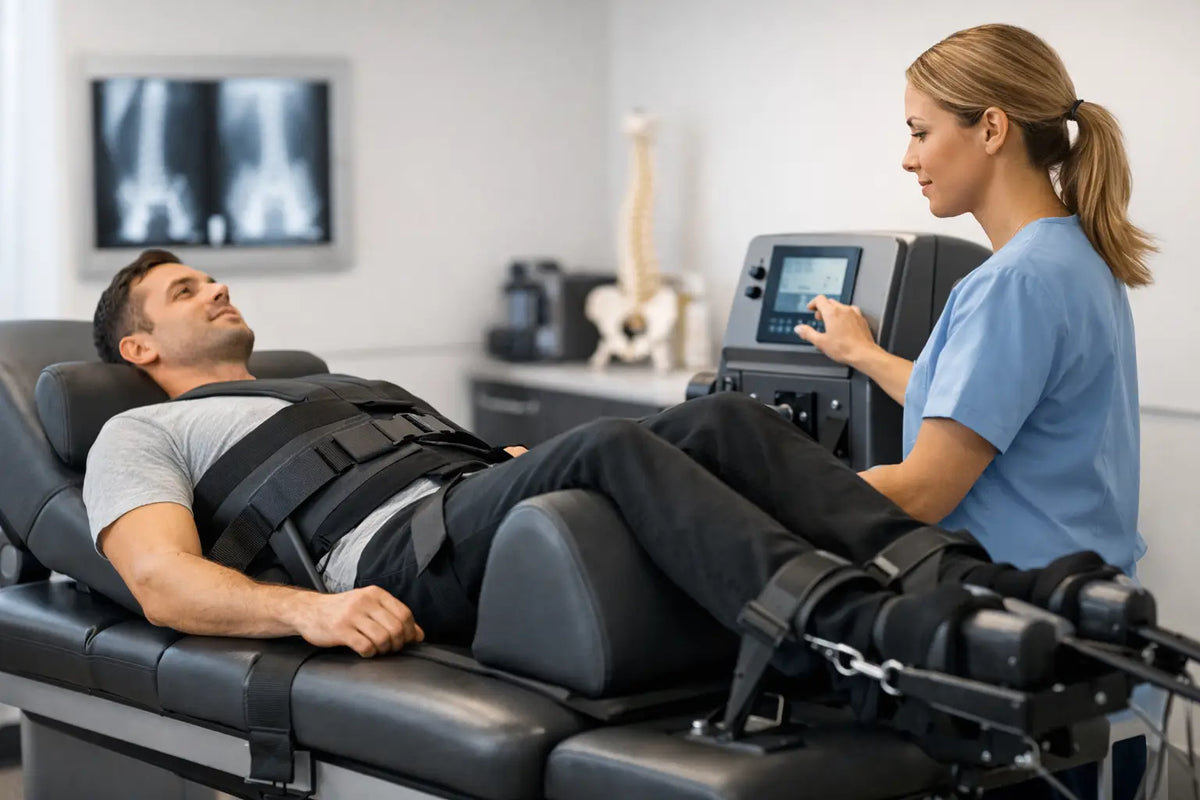
A decompression session can look smooth from across the room while still missing the clinical variables that determine whether a patient tolerates and benefits from care. A guide to decompression patient protocols should therefore begin before the patient reaches the table. The most reliable protocols connect screening, positioning, force selection, patient communication, and re-evaluation into one repeatable clinical process.
For chiropractic, physiotherapy, and multidisciplinary clinics, consistency matters as much as capability. A precision decompression table gives the practitioner controlled positioning and repeatable traction delivery. The protocol determines how that equipment is applied to the individual in front of you.
Start With Clinical Screening, Not Table Settings
Mechanical decompression is not a default intervention for every presentation of spinal pain. The clinician should establish a working diagnosis, document baseline symptoms and functional limitation, and determine whether traction-based loading is appropriate within the broader plan of care. This includes reviewing symptom behavior, irritability, neurologic findings, prior response to care, medication considerations, imaging or medical history when available, and the patient’s ability to understand and report changes during treatment.
Screen for conditions that may make spinal decompression inappropriate or require medical clearance. Depending on the region treated and the patient’s presentation, these can include suspected fracture or instability, active infection, malignancy, severe osteoporosis, acute inflammatory disease, progressive neurologic deficit, vascular concerns, recent surgery, or an inability to tolerate the required position and harnessing. Pregnancy, joint hypermobility, significant anxiety, and certain implanted devices may also change the clinical decision. Device instructions, local scope-of-practice requirements, and the referring provider’s direction should always govern.
The practical point is simple: do not allow a familiar diagnosis label to replace screening. Two patients with similar imaging findings can have very different loading tolerance, treatment goals, and risk profiles.
Establish a baseline you can measure
Before the first session, record the metrics you will use to judge response. Pain intensity alone is not enough. Note the patient’s primary aggravating movement, symptom distribution, active range of motion, relevant neurologic findings, and a functional task that matters to that patient, such as sitting, walking, transfers, lifting, or sleep tolerance.
This baseline helps prevent a common protocol failure: continuing treatment because the session felt comfortable even though the patient’s meaningful function is not improving. It also gives the clinical team a clean reference point when adjusting dosage.
Guide to Decompression Patient Protocols: Build the First Session Conservatively
The initial session is an assessment as much as a treatment. The goal is not to reach an aggressive traction setting. It is to identify a position and loading range the patient can tolerate without adverse symptom behavior during the session or after leaving the clinic.
Begin by explaining what the patient may feel: a gradual pulling sensation, pressure through the harness, and the ability to stop or report discomfort at any time. Be equally direct about what is not acceptable. Increasing sharp pain, spreading symptoms, new numbness or weakness, dizziness, nausea, or significant distress should prompt an immediate response and clinical reassessment.
Positioning has a major effect on treatment delivery. Select prone or supine positioning based on the treatment region, the patient’s directional preference, respiratory comfort, hip and knee tolerance, body habitus, and ability to relax. Secure the thoracic and pelvic harnesses firmly enough to control unwanted movement, but not so tightly that they create pressure pain, restrict breathing, or encourage guarding. A stable table platform and controlled elevation are operational advantages here: they allow clinicians to position patients safely and avoid unnecessary transfers or awkward practitioner body mechanics.
For lumbar applications, starting force, hold time, rest cycles, and total treatment time should be individualized and intentionally modest. Published approaches and manufacturer settings may provide a framework, but they are not a substitute for patient-specific clinical reasoning. Smaller patients, highly irritable presentations, and individuals new to traction commonly warrant a more cautious entry point. Larger patients or those with lower symptom irritability may tolerate more load, but body weight alone should never dictate dosage.
Cervical protocols require the same restraint, with additional attention to head position, jaw comfort, headache history, vascular screening considerations, and neurologic symptoms. The ability to communicate clearly throughout treatment is especially important when the patient is positioned with a cervical harness.
Use Symptoms to Guide Progression
A decompression plan should progress according to response, not a fixed calendar. Some patients may tolerate a gradual increase in force, session duration, or total treatment exposure. Others may respond better to holding the same dosage while mobility, exercise tolerance, and daily function improve. More force is not automatically better treatment.
Reassess immediately after the session and again at the next visit. Ask whether symptoms changed during traction, in the first few hours afterward, and the following morning. Document whether the patient’s familiar symptoms centralized, reduced, remained stable, or worsened. Also check the functional marker identified at baseline.
A favorable response may support careful progression. A delayed flare, peripheralization of symptoms, prolonged soreness, or new neurologic complaints calls for reducing the dose, changing positioning, pausing decompression, or referring for further evaluation as appropriate. The patient’s response to the total care plan matters more than the response to one machine cycle.
Pair decompression with active rehabilitation
Decompression is usually most useful when it supports a larger plan rather than standing alone. After the patient is off the table and reassessed, use the window of symptom reduction or improved movement to reinforce active care. That may include graded walking, directional-preference exercise, trunk or cervical stabilization, hip mobility, manual therapy when indicated, ergonomic education, and a home program matched to irritability.
This sequence improves clinical efficiency. The table addresses a specific loading objective; active rehabilitation helps the patient build capacity for the demands that provoked symptoms in the first place. For high-volume clinics, documenting this sequence also makes the treatment plan easier for associate providers and support staff to follow consistently.
Standardize the Workflow Without Making Care Generic
A strong clinic protocol has standard checkpoints, not identical settings for every patient. The workflow should make it difficult to skip safety steps while leaving the clinician free to individualize treatment.
At minimum, the record should capture the treated region, patient position, harness configuration, force or intensity settings, cycle pattern, total time, symptoms before and after treatment, and the next planned adjustment. If a patient experiences an adverse response, document the details rather than simply noting that they “did not tolerate” treatment. Specifics make the next clinical decision clearer.
Operational details deserve attention as well. Inspect straps, buckles, cables, table movement, emergency stop functions, and upholstery regularly. Clean contact surfaces between patients according to clinic infection-control procedures. Train every team member on safe transfers, table controls, patient communication, and escalation procedures. Premium equipment is built for serious treatment rooms, but dependable performance still depends on disciplined daily use and preventive maintenance.
Know When to Stop, Refer, or Change Course
Decompression should earn its place in the plan of care through measurable progress. If baseline pain, function, and examination findings are not improving after an appropriate trial, reassess the diagnosis, dosage, and treatment strategy. Continuing the same protocol without a rationale consumes appointment capacity and can weaken patient confidence.
Urgent changes in neurologic status, bowel or bladder symptoms, unexplained systemic illness, severe unremitting pain, or other red flags require prompt medical evaluation rather than additional table-based treatment. Clinics should have a clear escalation pathway so that the team knows who contacts the provider, how the patient is instructed, and what is documented.
The best decompression protocol is not the most complicated one. It is the one your clinical team can execute precisely, explain clearly, measure honestly, and adjust quickly when the patient’s response calls for a different path.
Share:
Manual Versus Powered Tables for Clinics
Traction System Setup for Clinical Precision