


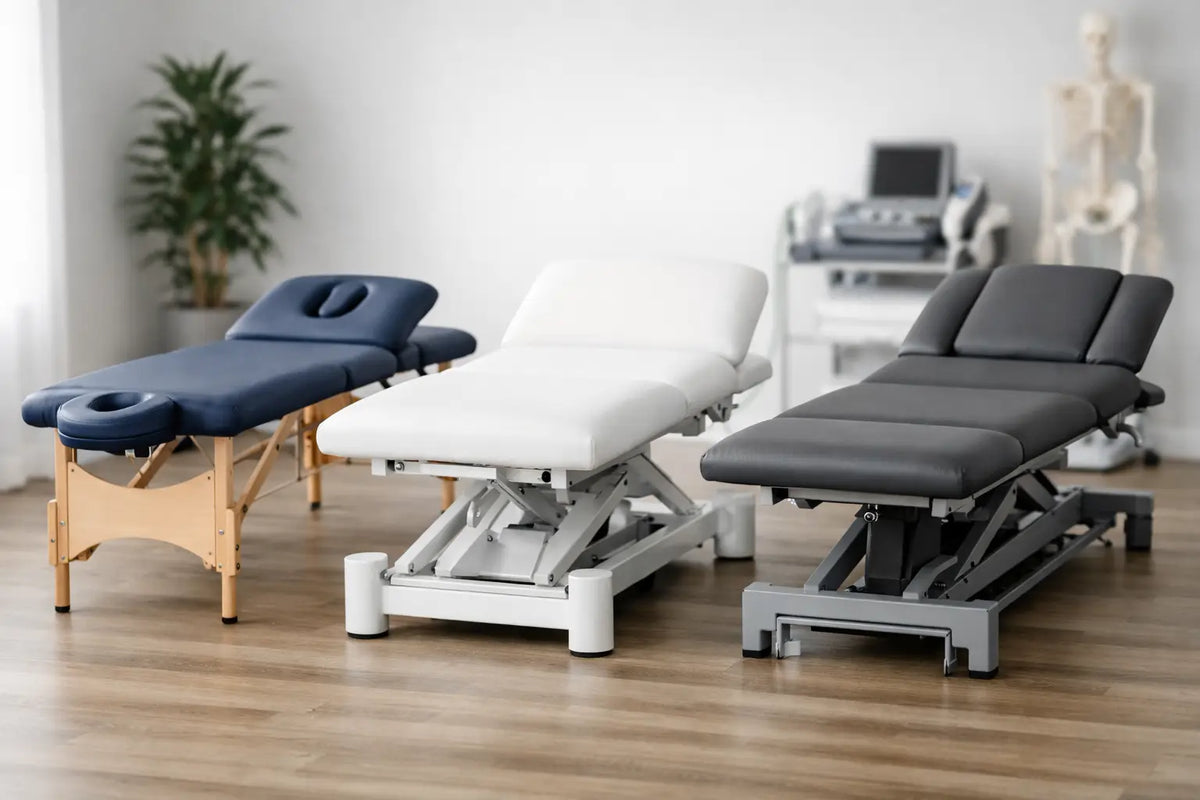
A treatment table comparison should begin where the day actually gets difficult: the fully booked afternoon, the larger patient who needs confident transfers, the therapist adjusting height between appointments, and the clinician who cannot afford table movement during a precise procedure. A treatment table is not room furniture. It is a working clinical platform that affects positioning, practitioner mechanics, patient confidence, and treatment throughput.
The right choice depends on the care you provide most often, not the broadest feature list on a product page. A massage-focused room may prioritize quiet elevation and patient comfort. A chiropractic practice performing flexion distraction needs controlled sectional movement and structural stability. A multidisciplinary rehabilitation clinic may need a high-capacity hi-lo table that accommodates transfers, manual therapy, traction, and mobility work without becoming a bottleneck.
Treatment Table Comparison: Start With Clinical Use
Before comparing motors, upholstery, or accessories, define what happens on the table. A general-purpose table can serve many basic needs, but it may create compromises when treatment techniques become more specialized.
For chiropractic care, consider whether your clinicians perform manual adjustments only or routinely use flexion distraction, drops, pelvic work, cervical procedures, or decompression protocols. These applications require more than a flat, elevated surface. Section design, patient positioning, controllable motion, and access to the treatment area directly influence how accurately the technique can be delivered.
For physical therapy and rehabilitation, the central questions are often transfer safety, adjustable working height, load capacity, and the ability to position patients for exercise, mobilization, manual therapy, and recovery work. A low starting height can make access easier for older adults and mobility-limited patients. A reliable electric lift helps clinicians move from low-transfer height to a comfortable working height without interrupting the appointment.
Massage professionals may place stronger emphasis on face cradle configuration, comfort foam, quiet operation, and a stable surface that remains secure under sustained hands-on work. Yet durability still matters. A table used for multiple appointments every day needs a frame, lift system, and upholstery built for professional repetition, not occasional home use.
Compare the Frame Before the Features
A table can look sophisticated and still feel underbuilt when the patient shifts position. Frame quality is the foundation of clinical performance. During a treatment table comparison, inspect the stated weight capacity, base geometry, weld quality, and how the frame behaves under off-center loading.
Capacity is not merely a number on a specification sheet. A 600 lb rated table, for example, offers a larger margin for a broader patient population and for the added forces created when a practitioner applies manual pressure. The goal is not to treat the rating as a target. It is to select equipment with adequate structural reserve for normal clinical use over years of repeated cycles.
Base design also affects access. A rigid, well-engineered base reduces unwanted flex and movement, while leaving enough foot clearance for the clinician to work close to the table. This is especially relevant in high-volume chiropractic and rehab settings, where small workflow irritations become repeated strain over hundreds of visits.
Ask a practical question: does the table feel planted when the patient turns, transfers, or receives a manual technique? If the answer is uncertain, premium upholstery or extra accessories will not correct the underlying problem.
Why lift systems deserve close attention
Motorized elevation is often treated as a convenience feature. In a serious treatment room, it is a workflow and ergonomics feature. A dependable hi-lo system allows patients to get on and off at a safer height, then brings the working surface to the clinician rather than forcing the clinician into repeated bending or reaching.
Compare the lift range, speed, smoothness, control placement, and noise level. Foot controls can be valuable during manual treatment because they allow height adjustment without breaking contact or reaching for a hand switch. Hand controls or touchscreen interfaces may provide more precise positioning and make functions easier to standardize across a team.
There is a trade-off. More powered functions can improve efficiency and treatment options, but they also make service access, parts availability, and manufacturer support more significant. The better question is not whether a table has the most motors. It is whether each motor supports the way your clinicians work.
Section Design Determines Treatment Access
A flat treatment table is appropriate for certain practices. It is also limiting when a treatment method depends on controlled regional positioning. Multi-section tables offer targeted support for the head, thoracic region, pelvis, legs, or cervical area, which can improve both patient comfort and practitioner access.
In chiropractic applications, flexion distraction tables are designed around controlled motion rather than simple elevation. The quality of that movement matters. Look for repeatable travel, stable locking positions, accessible controls, and sectional architecture that supports the techniques your practice uses. If a table’s motion feels abrupt, loose, or difficult to regulate, it can work against treatment precision.
For decompression and traction, assess whether the table is designed to integrate with the system rather than simply accommodate it. Patient stabilization, pelvic and thoracic positioning, and repeatable setup are central to a productive protocol. A loosely matched table and traction unit can create inconsistent positioning and extend setup time from one patient to the next.
For PT and multidisciplinary care, adjustable head sections and split-leg configurations can help with prone work, supine positioning, lower-extremity access, and certain exercise-based interventions. More sections are not always better. Each added section should solve a real positioning requirement, not add complexity to a room where clinicians primarily need a stable, versatile platform.
Patient Comfort Is a Performance Requirement
Patients notice the table before treatment begins. They notice whether it feels secure during transfers, whether the surface is supportive, whether the face opening is comfortable, and whether the table changes position smoothly. Those details shape confidence, particularly for patients dealing with pain, neurological symptoms, post-surgical restrictions, or mobility concerns.
Comfort should not be separated from clinical function. Foam density needs to support the patient without allowing excessive sinking that compromises positioning. Upholstery should be durable, easy to clean, and appropriate for the disinfecting routine in your facility. Edge finishing, face cushion design, and section gaps also matter because pressure points become more apparent during longer appointments.
A wider table can improve patient comfort and accommodate varied body types, but it may reduce practitioner reach. A narrower surface can improve access for manual therapy, yet may feel less secure for some patients. The best width depends on your patient mix, clinical techniques, and whether the table is shared across disciplines.
Calculate Value Over the Table’s Working Life
Purchase price is visible. Downtime, slow adjustments, premature upholstery wear, and staff fatigue are less visible, but they influence the real cost of equipment ownership. Clinics should compare tables through the lens of years of service, not the first invoice alone.
A lower-cost table may be a reasonable fit for occasional use or a limited-scope room. It becomes a poor value when it is expected to carry a full daily schedule, support heavier loads, or provide specialized motion it was not engineered to deliver. Conversely, a highly specialized table may be unnecessary if your practice does not perform the procedures that justify it.
Evaluate warranty terms, frame coverage, replacement-part availability, service responsiveness, and the likelihood that controls or accessories can be supported over time. Financing can also affect the decision. Spreading the cost of a clinic-grade table may allow a growing practice to select equipment that meets its current workload rather than settling for a short-term compromise.
Match the Table to the Room, Not Just the Specialty
Even the right table can underperform when it is poorly matched to the room. Measure clearance around the base, door access, electrical placement, and the space required for the clinician to move on both sides. For traction or decompression equipment, account for the full treatment setup rather than the table footprint alone.
Also consider who will use the room. A dedicated flexion distraction room can justify a focused configuration. A shared room serving chiropractic, physical therapy, and massage may benefit more from a high-capacity motorized table with adaptable sections and simple controls. Standardizing key controls across multiple rooms can reduce staff training time and make patient flow more consistent.
TRL Tables is built around this clinical reality: the table should support the treatment method, protect practitioner workflow, and stand up to the demands of daily professional use. Choose the platform that makes your most common procedures more controlled, not merely more possible.
Share:
Best Physiotherapy Treatment Tables for Clinics
Flexion Distraction Table Review for Clinics