


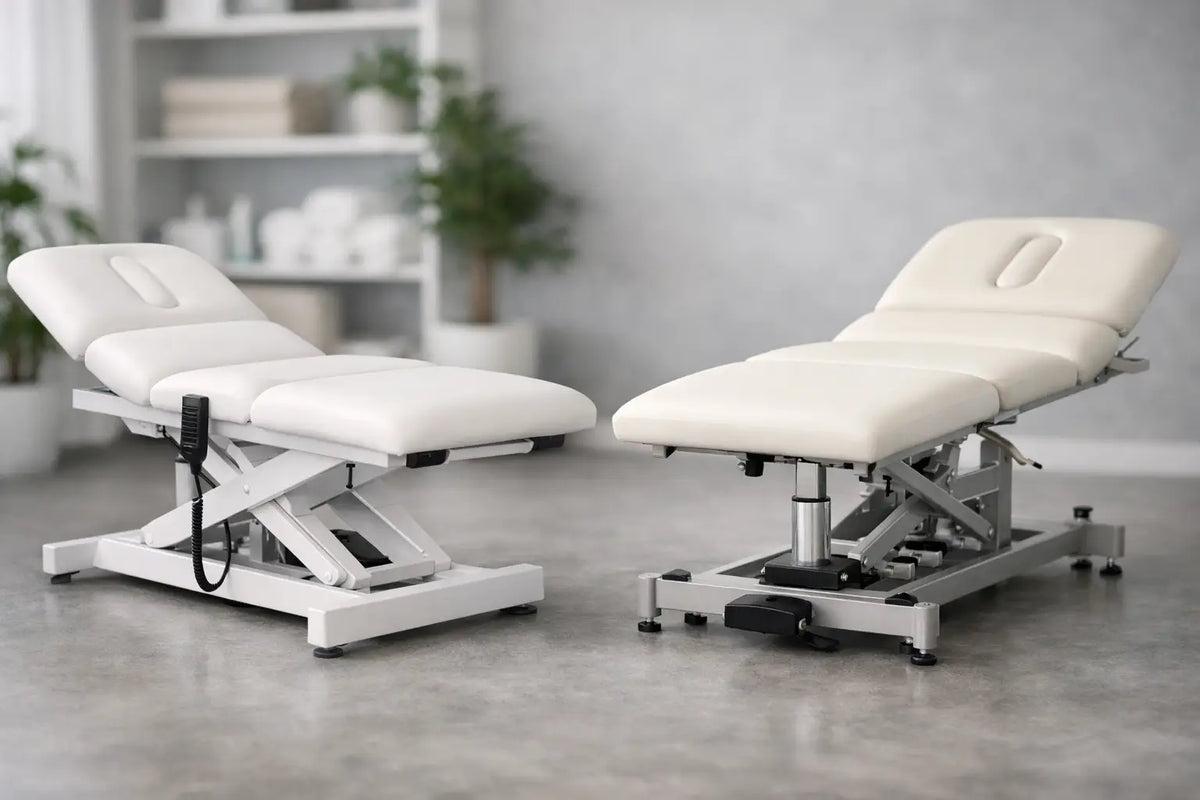
A table that takes too long to adjust can disrupt an otherwise efficient treatment plan. It can also force clinicians into compromised working positions, make transfers harder for patients, and create friction between appointments. The electric vs hydraulic treatment table decision is not simply about how a table goes up and down. It is a decision about daily workflow, patient access, treatment precision, and the level of performance your clinic needs to maintain.
For a low-volume room with straightforward treatment needs, either system may be appropriate. For a busy chiropractic, physical therapy, massage, or multidisciplinary practice, the differences become more visible with every patient, every transfer, and every adjustment.
Electric vs Hydraulic Treatment Table: The Core Difference
An electric treatment table uses a powered motor and control system to raise or lower the patient surface. Depending on the model, the clinician may operate it through a foot control, hand control, or integrated switch. The table moves with consistent powered elevation, allowing fast adjustments without manual pumping.
A hydraulic treatment table relies on a hydraulic pump, usually activated by a foot pedal. Each pump cycle raises the table incrementally, while a release mechanism lowers it. This design does not require electrical power for elevation, which can be useful in certain settings, but it requires more clinician input to reach the desired working height.
Neither system is automatically better in every environment. The right choice depends on the treatments you perform, the number of patients you see, the physical demands placed on staff, and how much adjustment range matters during a typical visit.
Why Electric Tables Lead in High-Volume Clinics
Electric elevation is built for repeatable, controlled workflow. A clinician can bring the surface low for a patient with mobility limitations, then raise it to an ergonomic treatment height without interrupting the setup or manually pumping a pedal. That matters when a room turns over frequently or when the table is adjusted several times during one session.
For chiropractic and rehabilitation providers, a powered hi-lo table can also support more deliberate patient positioning. Lowering the table for access and raising it for palpation, mobilization, soft tissue work, traction setup, or flexion distraction helps keep the clinician closer to a neutral working posture. Over hundreds of appointments, that operational advantage is substantial.
Electric systems are especially practical when the table is part of a more advanced treatment platform. Motorized elevation pairs naturally with features such as sectional drop mechanisms, adjustable pelvic and thoracic sections, flexion distraction, decompression, or traction components. These functions demand stable positioning and a frame engineered to remain rigid under active clinical use.
The strongest electric tables also create a more polished patient experience. Controlled, smooth elevation can feel more secure for older adults, post-surgical patients, and anyone who has difficulty stepping onto a fixed-height surface. It signals that the room was designed for professional care rather than adapted around basic furniture.
The Operational Value of Foot Controls
A foot control may seem like a minor feature until a clinician is working through a full schedule. It keeps both hands available for patient support, documentation, and treatment preparation. Instead of bending down or pausing to operate a manual pump, the practitioner can make height adjustments while maintaining attention on the patient.
This is particularly valuable during transfers. When a patient needs the table at its lowest practical entry height, powered control allows the clinician to position the surface quickly and precisely. Once the patient is secure, the table can be elevated to the preferred working level without adding unnecessary physical effort.
Where Hydraulic Treatment Tables Make Sense
Hydraulic tables remain a practical choice for certain providers. Their mechanical simplicity can appeal to clinics that want a lower initial investment, have modest treatment volume, or need a table in a room where electrical access is limited. They can also work well in treatment settings where height changes are infrequent and the clinician does not need rapid repositioning throughout the visit.
A hydraulic table can be an appropriate fit for massage-focused care, occasional-use rooms, satellite spaces, or practices with a narrow range of treatment protocols. The system is familiar, direct, and not dependent on a motor for elevation.
The trade-off is cumulative effort. Raising a hydraulic table requires repeated pumping, particularly when moving from a low patient-entry position to a higher working height. That may not be a major issue for a few appointments per day. In a high-volume clinic, however, it adds time and physical repetition that staff members will notice.
Hydraulic elevation may also offer less convenient mid-treatment adjustment. If a clinician needs to change the table height while supporting a patient or transitioning between techniques, the manual process can be less efficient than a powered system.
Compare Performance Beyond the Lift Mechanism
The lift system matters, but it should not be the only specification driving the purchase. A treatment table is a working platform. Its stability, load capacity, frame design, section control, upholstery quality, and serviceability all affect whether it holds up under daily clinical demand.
Start with capacity. A clinic-grade table should be engineered to accommodate a broad patient population with confidence. A 600 lb capacity provides a stronger margin for heavier patients, active treatment, and the real-world demands placed on the frame during transfers and repositioning.
Next, assess stability at full elevation. A table that rises smoothly but feels unstable at working height can undermine treatment accuracy and patient confidence. Look for a durable steel frame, wide base geometry, quality welds, and a platform designed to resist flex during manual therapy, adjustments, and repeated loading.
Then consider the treatment surface itself. For chiropractic and rehab applications, sectional design matters. Headrest adjustment, abdominal or thoracic sections, pelvic movement, drop functionality, and flexion capabilities should align with how you actually treat. An electric hi-lo base can improve access, but it cannot compensate for a top section that limits your clinical methods.
Finally, ask about long-term support. Motors, controls, upholstery, moving sections, and mechanical components are service items over the life of a professional table. Parts availability and knowledgeable support protect the investment far more effectively than a low purchase price alone.
Match the Table to Your Clinical Workflow
The best way to choose is to trace a normal appointment from patient entry to discharge. Consider how low the table needs to go for safe access, how often you adjust height, whether multiple providers share the room, and which techniques require a specific working level.
A chiropractor using flexion distraction, drops, traction, or decompression may benefit significantly from electric elevation because the table becomes a precise treatment platform rather than a static surface. A physical therapist treating post-operative, neurologic, or mobility-limited patients may prioritize low entry height and controlled lifting for transfers. A massage therapist with a consistent client population and limited height changes may find a hydraulic model sufficient, provided the frame and upholstery are rated for professional use.
Growing clinics should also account for where the practice is heading. Buying for current appointment volume alone can create a bottleneck when additional providers, longer hours, or broader patient demographics enter the picture. A powered table is often the more scalable choice when the treatment room must perform across several disciplines and patient needs.
Cost, Reliability, and Return on Investment
Hydraulic treatment tables generally have a lower entry cost because the elevation mechanism is mechanically simpler. For a provider opening a small practice with limited capital, that difference can be meaningful.
Electric tables typically require a greater upfront investment, but the evaluation should extend beyond the purchase price. Faster room flow, better ergonomics, easier patient access, and reduced repetitive pumping can create a stronger long-term return in a busy practice. If a table is used all day, the value of controlled motorized elevation is measured in more than minutes saved.
Reliability depends heavily on build quality. A well-engineered electric table with a durable motor system, strong frame, and accessible service support is designed for serious treatment rooms. A poorly built powered table can become an expensive interruption. The same is true of hydraulic equipment: a basic pump does not make up for a weak frame, inadequate capacity, or unstable construction.
For clinics investing in premium equipment, warranty coverage is another practical signal. A lifetime frame warranty reflects confidence in the structural component that carries the greatest load over the table's service life. It should be paired with clear support for the systems that make the table function day after day.
The Better Choice Depends on How Hard Your Table Works
Choose hydraulic when your treatment volume is modest, height adjustments are occasional, and a mechanically simple, lower-cost system fits the room. Choose electric when your clinicians adjust height often, treat patients with varied mobility needs, require ergonomic working positions, or operate a high-volume schedule.
For most professional clinics, electric elevation provides the more capable long-term platform. It supports faster setup, more controlled patient access, and a workflow that does not ask clinicians to work around their equipment. TRL Tables designs clinic-grade treatment tables around that standard: stable under load, precise in operation, and built to keep performing when the schedule does not slow down.
Before you decide, stand in the place where the table will be used and picture the hundredth appointment of the week. The right table is the one that still feels stable, efficient, and clinically ready when the room is working at full capacity.
Share:
Motorized Elevation Treatment Tables for Clinics
Best Physiotherapy Treatment Tables for Clinics